

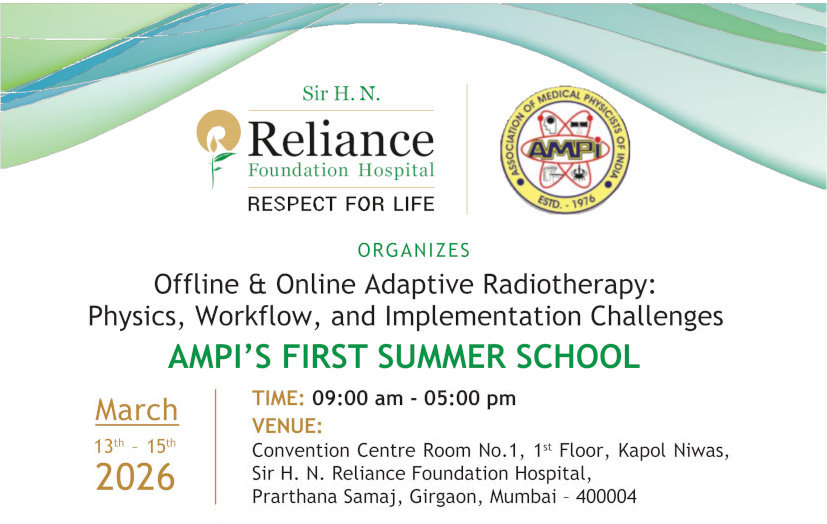
A long-felt need among practicing medical physicists in India of comprehensive academic programs on contemporary topics of relevance eventually culminated in the first AMPI Summer School. The school, held from March 13–15, 2026 at Sir H. N. Reliance Foundation Hospital, Mumbai, turned out to be a landmark initiative aimed at strengthening advance clinical knowledge among medical physicists. It brought together experts and participants for an intensive three-day academic interaction on the topic of the school.
A total of around 40 participants attended the program in an ideal environment for meaningful discussion, peer learning, and exchange of practical experiences. The scientific program was the cornerstone of this summer school, carefully structured to cover the entire spectrum of adaptive radiotherapy—from fundamental physics concepts to real-world clinical implementation.
The program began with an over view on the evolution of adaptive radiotherapy, including transitions from IGRT to online ART, followed by in-depth lectures on deformable image registration (DIR), artificial intelligence applications, and ICRU 97 recommendations on dose accumulation. Subsequent sessions focused on practical workflows such as “plan of the day” strategies, CBCT-guided and MR-guided adaptive platforms, and the critical “scan–plan–treat” paradigm.
Importantly, the scientific agenda maintained a strong emphasis on clinical translation. The sessions on commissioning, end-to-end validation, and real-time dosimetric verification provided valuable insights into implementing ART safely in routine practice. Advanced topics such as synthetic data usage, AI-based contouring, PET-guided ART, and adaptive radiotherapy in proton therapy further enriched the academic depth of the program.
The inclusion of case studies and panel discussions was particularly impactful. Discussions on sustainability of online ART—addressing technology burden, manpower requirements, and patient impact—along with sessions on building an adaptive radiotherapy program from a clinical learning curve perspective, ensured that participants could relate theoretical knowledge to practical challenges.
Feedback received from the participants reflects the success of the scientific program, with high ratings across parameters such as lecture quality, relevance to clinical practice, and opportunities for discussion. Participants highlighted the strong clinical orientation, hands-on relevance, and exposure to emerging technologies like AI and adaptive workflows.
Dedicated efforts at every step lead to the success of the first AMPI Summer School. Formulation of clear guidelines and financial support with required flexibility, and formation of a standing committee by EC of AMPI set the ball rolling. Dr Sudesh Deshpande, convenor/chairman of the scientific committee played the most crucial role in making this happen. The active support and interventions from DrsRaghvendra Holla and C P Bhattensured a high-quality scientific agenda. In the absence of any prior template or precedence, it was a real challenge for the scientific &organizing committees to set a bench mark for future schools. It was also gratifying to note that the participants took part in lively interactions with the faculty. The punctuality of the sessions without any fanfare, usually associated with symposia/workshops/conferences, was yet another hall-mark of the school.
AMPI is grateful to the outstandingpioneering contribution of Drs Deshpande, Holla, Bhatt and team. I will be failing in my duty if I don’t acknowledge the significant contribution of Mr Anand Jadhav & team of medical physicists & RTTs along with Dr P Dandekar, chairman organizing committee at Sir HN RFH, Mumbai, the host medical institution.
All in all, the first AMPI Summer School fully met the objectives set for it in fostering knowledge exchange, professional interaction, and advancement in adaptive radiotherapy practices. I am sure it will translate into improved patient care and safety in RT clinics and pave the way for future AMPI Summer Schools on regular basis.
Manoj K Semwal, DipRP, PhD
President, AMPI